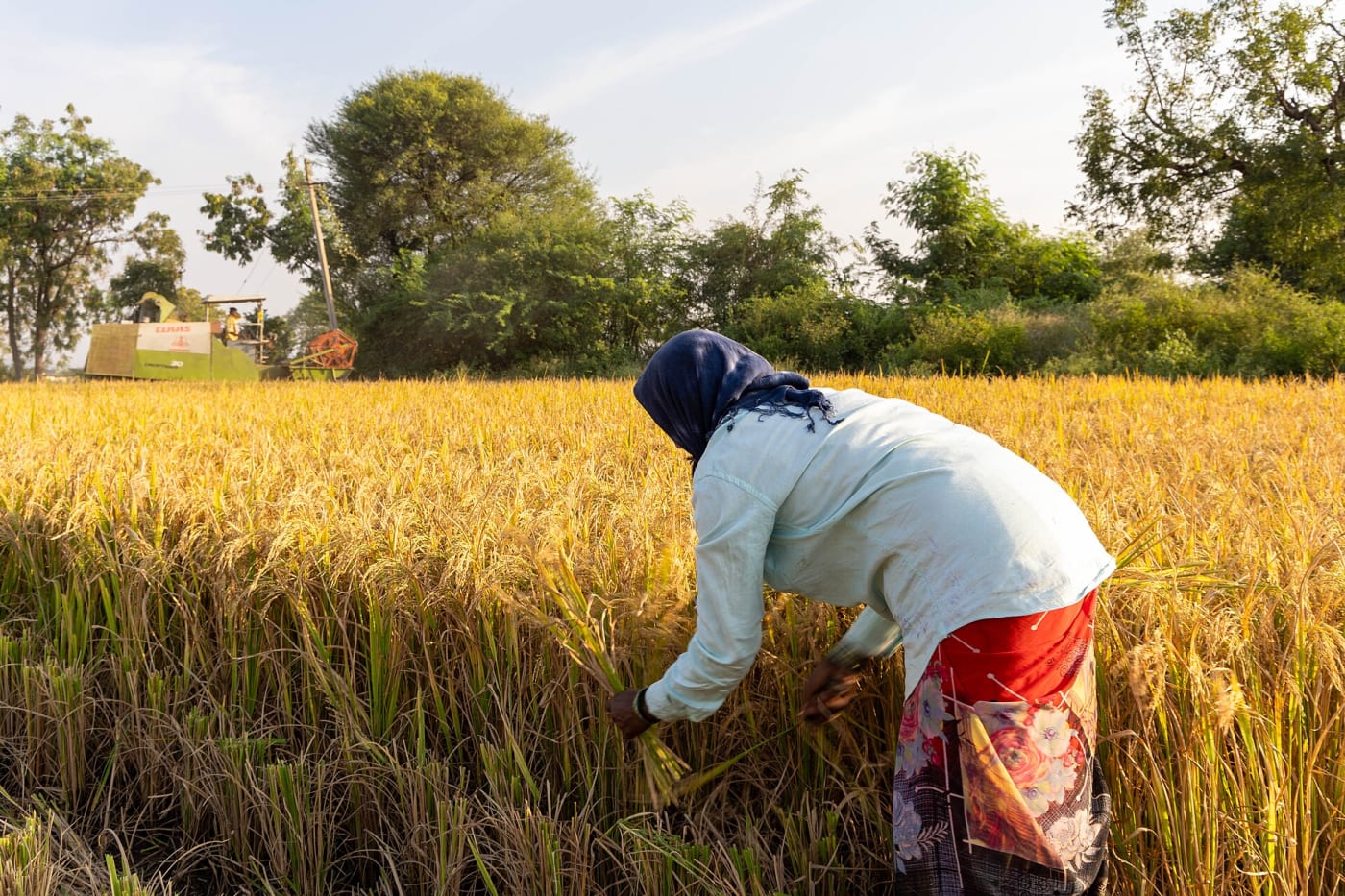
Support to farmers had historically flowed through price and input subsidies — fertiliser, power, minimum support prices — which are indirect, hard to target, and captured disproportionately by larger landholders. The small and marginal farmer, who accounts for about 86% of India's farm holdings, typically had no working capital at sowing time and borrowed from a moneylender at rates that ate the season's margin.
PM-KISAN Income Support
PM-KISAN Income Support
PM-KISAN, launched in February 2019, pays ₹6,000 a year to eligible landholding farmer families in three instalments, sent straight to the bank account with no intermediary. It is one of the world's largest direct benefit transfer programmes: more than 11 crore farmer families have benefited, and over ₹4.47 lakh crore has been paid across 23 instalments. Aadhaar seeding and land-record linkage removed ineligible beneficiaries and made every payment traceable. The counter shows cumulative transfers.
₹4.47 L cr
Transferred since 2019
11 cr+
Farmer families covered
₹6,000
Per year, in 3 instalments
Transferred to farmers (23 instalments, to June 2026)
| Year | Cumulative transfers |
|---|---|
| 2020 | 0.51 Rs lakh cr |
| 2021 | 1.60 Rs lakh cr |
| 2022 | 2.00 Rs lakh cr |
| 2023 | 2.60 Rs lakh cr |
| 2024 | 3.45 Rs lakh cr |
| 2026 | 4.47 Rs lakh cr |
| Dashed bars are years the source does not publish; the shape between published years is drawn, not measured. | |
2020
0.00Rs lakh cr
Cumulative transfers
20202026
Since 2020
Added
+3.96 Rs lakh cr
2020
0.51 Rs lakh cr
2026
4.47 Rs lakh cr
Dashed bars are years the source does not publish; the shape between published years is drawn, not measured.
Why it matters Small and marginal farmers — about 86% of India's farm holdings — rarely had working capital at sowing time and borrowed from moneylenders at punishing rates. A predictable transfer three times a year lets them buy seed and fertiliser without debt. Because it goes account-to-account, none of it is lost on the way.
- Over ₹4.47 lakh crore transferred through 23 instalments since 2019; more than 11 crore farmer families have benefited.
- ₹6,000 a year in three instalments, paid directly into the beneficiary's bank account.
- One of the world's largest direct benefit transfer programmes; continued to 2030-31 with ₹3.15 lakh crore.
- Complemented by PM Fasal Bima Yojana crop insurance and the soil health card programme.
History
Notable milestone
PM-KISAN launched in February 2019 and is one of the world's largest direct benefit transfer programmes. More than 11 crore farmer families have benefited, and over ₹4.47 lakh crore has been paid across 23 instalments — straight into the bank account, with no intermediary; States verify who is eligible.
How it works
Eligible landholding farmer families receive ₹6,000 a year in three instalments of ₹2,000, one every four months. Registration is linked to Aadhaar and digitised land records, and payment runs on the Public Financial Management System — so each transfer is traceable end to end. That linkage also let the government remove ineligible and duplicate beneficiaries from the rolls, which no earlier farm subsidy could do.
Outlook
PM-KISAN sits inside a wider farm package: PM Fasal Bima Yojana crop insurance, the soil health card programme, e-NAM electronic mandis, the Agriculture Infrastructure Fund, and 10,000 new Farmer Producer Organisations. Together they aim to shift the farmer from price-taker to a producer with credit, insurance, storage and market access.
By the numbers
₹4.47 lakh crore+ transferred since February 2019. 11 crore+ farmer families have benefited. ₹6,000 a year in three instalments. 23 instalments paid (to June 2026). One of the world's largest direct benefit transfer programmes. Sources: Ministry of Agriculture & Farmers' Welfare, PIB.
Data current to: 31 July 2026
Source: Ministry of Agriculture & Farmers Welfare (via PIB) — cumulative PM-KISAN transfers since launch on 24 February 2019, ₹ lakh crore, at the latest date reported each year: 0.51 (February 2020), 1.6 (December 2021), 2.0 (October 2022), 2.6 (August 2023), 3.45 (October 2024) and more than 4.47 through 23 instalments (Cabinet, 31 July 2026, linked). The 23rd instalment reached 9.49 crore farmers, and the scheme has been continued to 2030-31 with ₹3.15 lakh crore. PIB's 2025 figures are inconsistent, so no 2025 point is shown. · link