India was once a modest refiner that even imported fuel. Refining was delicensed in 1998, letting private players in, and Reliance's Jamnagar (from 1999) grew into the world's largest refinery. From about 215 MMTPA of capacity in 2014, India climbed to 258 MMTPA by 2025 and 267 MMTPA on 1 April 2026 — becoming the world's fourth-largest refiner and one of the top seven exporters of petroleum products, despite importing most of its crude.
Oil Refining & Exports
Oil Refining & Exports
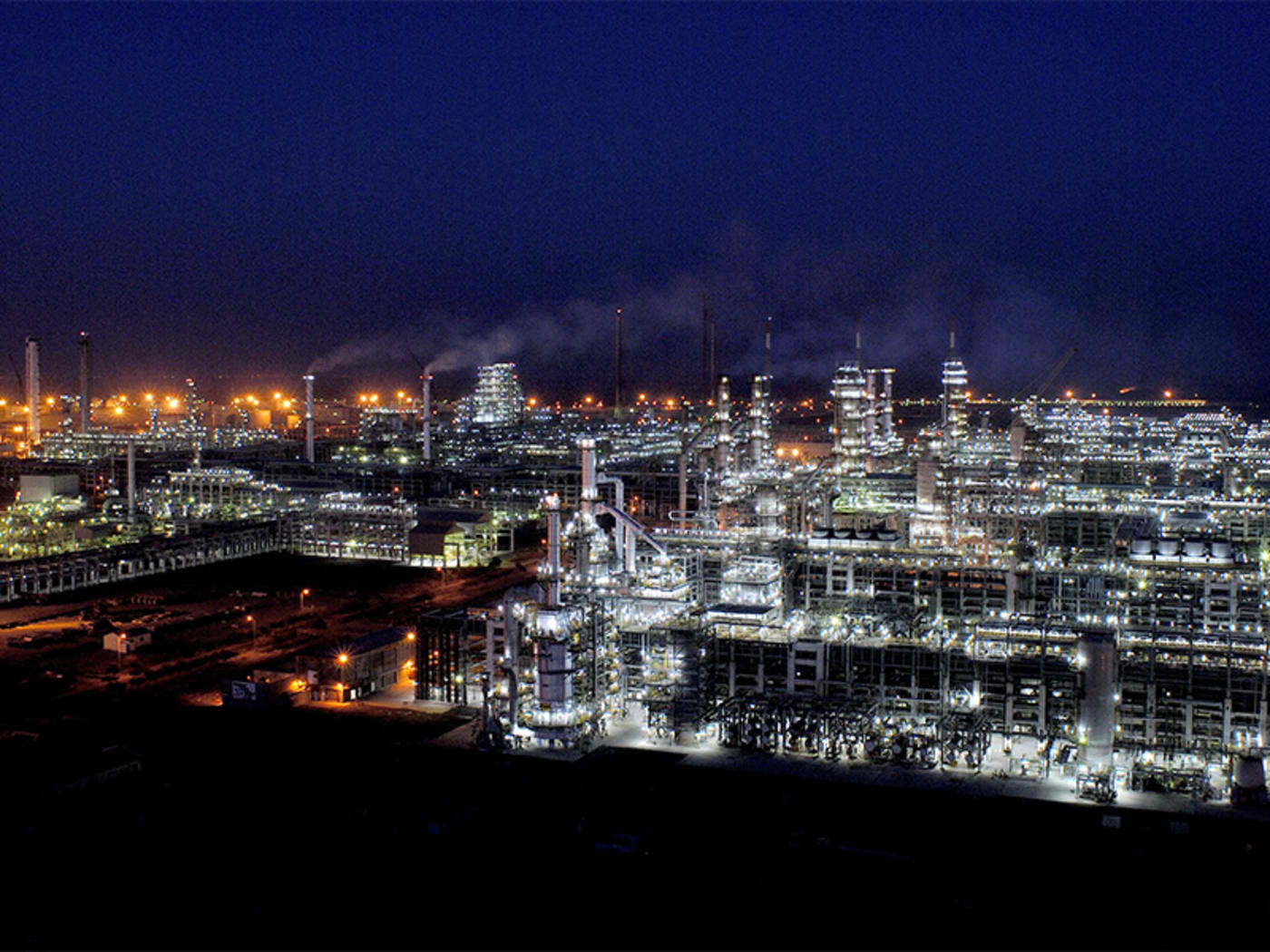
India is now the world's fourth-largest oil refiner. Installed capacity rose from about 215 MMTPA in 2014 to 258 MMTPA in 2025, across 22 operating refineries — including Reliance's Jamnagar, the world's largest refinery — and to 267 MMTPA on 1 April 2026, counting the new 9 MMTPA refinery at Pachpadra, Rajasthan (PPAC). India turns imported crude into higher-value products and exports them, ranking among the world's top exporters of refined petroleum — a strategic advantage built on world-scale refining capacity. The counter shows installed refining capacity.
4th
Largest refiner (world)
267 MMTPA
Refining capacity (1 April 2026)
309.5 MMTPA
Projected by 2030
Refining capacity, MMTPA (2014 → April 2026)
| Year | Refining capacity |
|---|---|
| 2014 | 215 MMTPA |
| 2015 | 215 MMTPA |
| 2016 | 230 MMTPA |
| 2017 | 234 MMTPA |
| 2018 | 248 MMTPA |
| 2019 | 249 MMTPA |
| 2020 | 250 MMTPA |
| 2021 | 249 MMTPA |
| 2022 | 251 MMTPA |
| 2023 | 255 MMTPA |
| 2024 | 257 MMTPA |
| 2025 | 258 MMTPA |
| 2026 | 267 MMTPA |
2014
0MMTPA
Refining capacity
20142026
Since 2014
Added
+52 MMTPA
2014
215 MMTPA
2026
267 MMTPA
Why it matters Refining turns imported crude into fuel, exports and jobs — letting India earn foreign exchange instead of only spending it on oil.
- Capacity: ~215 MMTPA (2014) → 258 MMTPA (2025) → 267 MMTPA (1 April 2026)
- 22 operating refineries; Jamnagar is the world's largest
- Among the world's top seven exporters of petroleum products; 309.5 MMTPA projected by 2030
- Source: MoPNG statistics; PIB
History
The refineries
India runs 22 refineries — 18 public, 3 private, 1 joint venture. Reliance's Jamnagar (about 68 MMTPA) is the world's largest refinery; IOCL, BPCL and HPCL anchor the public sector. Capacity is being expanded at existing refineries; the 9 MMTPA greenfield refinery-cum-petrochemical complex at Pachpadra in Balotra, Rajasthan, has been built, and the Cauvery Basin refinery at Nagapattinam is being expanded from 1 to 9 MMTPA.
Exported to the world
Instead of exporting crude, India exports higher-value products — petrol, diesel, aviation turbine fuel, naphtha and LPG — ranking among the world's top seven exporters of petroleum products, worth over $45 billion in 2024-25. Advanced refineries let India process cheaper heavy crude from many sources, and India's product exports reach more than 50 countries.
How it works
India runs one of the world's biggest refining systems — turning imported crude oil into petrol, diesel, jet fuel and petrochemicals across 22 refineries, both state-owned (IOCL, BPCL, HPCL) and private (Reliance's Jamnagar, the world's largest single refinery). Because India imports most of its crude but has surplus refining capacity, it exports the finished fuels — making India one of the world's top seven exporters of petroleum products.
Outlook
India is the world's fourth-largest refiner, with capacity of 267 MMTPA on 1 April 2026 and rising — plans would push it to about 310 MMTPA by 2030, with long-term plans for 400-450 MMTPA, to meet rising fuel demand and keep exporting. The next step is expanding domestic exploration and diversified sourcing to cut crude imports, and adding petrochemical capacity so refineries capture more value from every barrel.
By the numbers
Capacity 215.1 → 258.1 MMTPA (April 2014 → April 2025), 267.1 MMTPA on 1 April 2026 (PPAC); 22 operating refineries; Jamnagar the world's largest; product exports 61-65 MMT a year (2021-22 to 2025-26), over $45 bn in 2024-25; 309.5 MMTPA projected by 2030. Source: MoPNG statistics; PIB.
Data current to: 1 April 2026
Source: Ministry of Petroleum & Natural Gas — installed crude oil refining capacity (MMTPA) as on 1 April, 2014–2026, from its Indian Petroleum & Natural Gas Statistics: 215.066 MMTPA in April 2014 to 258.116 MMTPA on 1 April 2025. PIB, May 2026: the world's fourth-largest refiner, 258.1 MMTPA across 22 operational refineries. The Ministry's Petroleum Planning & Analysis Cell (PPAC): 267.116 MMTPA as on 1 April 2026, including the 9 MMTPA HPCL Rajasthan Refinery at Pachpadra (linked). · link