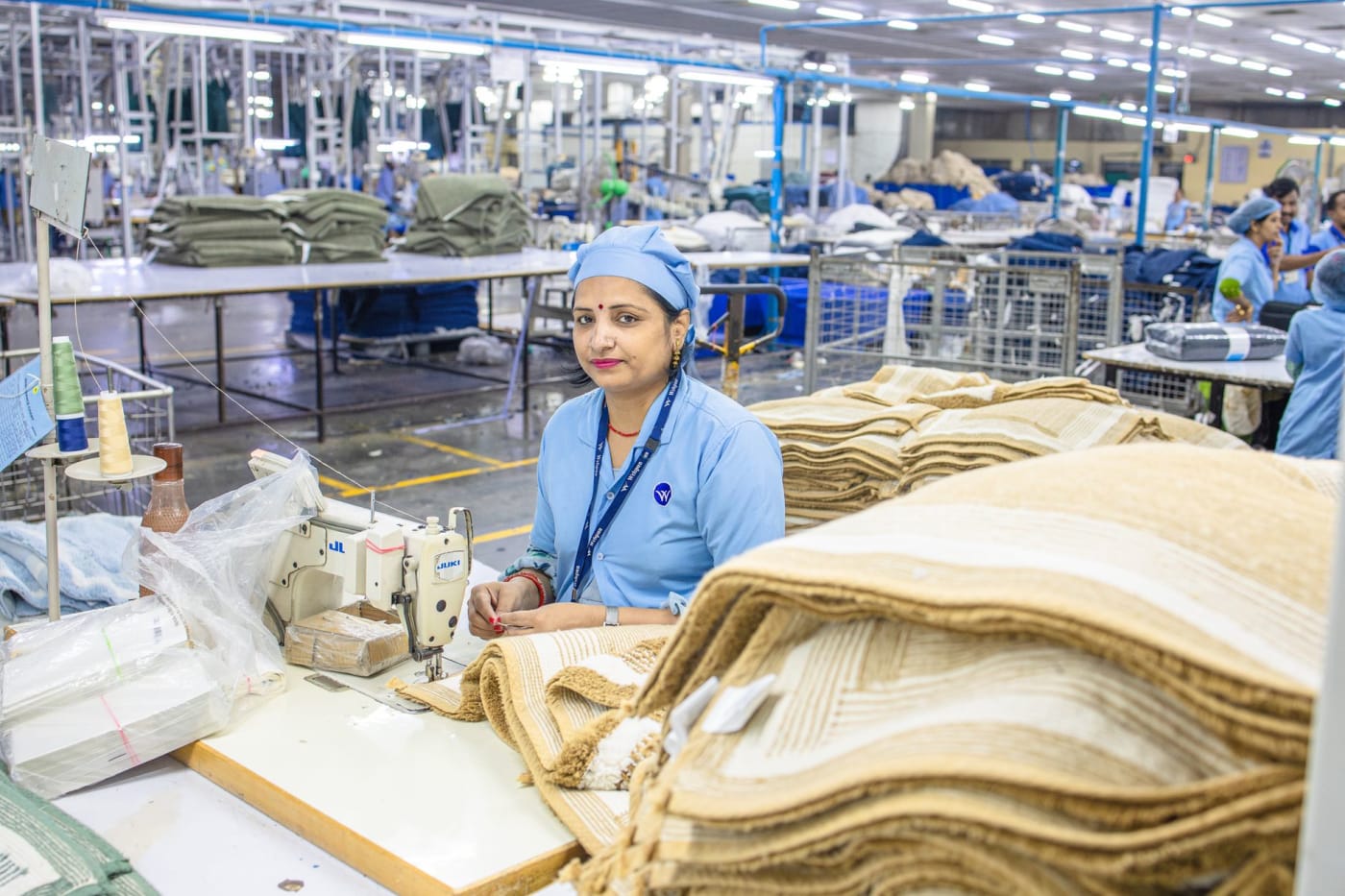
Textiles are among India's oldest industries and its second-largest employer after agriculture, supporting over 4.5 crore people across the value chain — cotton farming, spinning, weaving, and garment-making. The industry is valued at about $179 billion, including roughly $37 billion of exports, and India is the world's sixth-largest textile exporter, strong in cotton and increasingly in technical textiles.
Textiles
Textiles
Textiles are one of India's oldest industries and its second-largest employer, supporting over 4.5 crore people from cotton farms to garment factories. The industry is valued at about $179 billion — $142 billion domestic and $37 billion exports — and India is the world's sixth-largest textile exporter. This counter shows textile and apparel exports, including handicrafts, from DGCI&S data published by the Ministry of Textiles.
$179 bn
Industry size (2025)
~4.5 crore
People employed
6th
Largest textile exporter
Textile & apparel exports
| Year | Textile & apparel exports |
|---|---|
| 2015 | 38.2 $ bn |
| 2016 | 37.3 $ bn |
| 2017 | 37.4 $ bn |
| 2018 | 37.5 $ bn |
| 2019 | 38.4 $ bn |
| 2020 | 35.2 $ bn |
| 2021 | 31.6 $ bn |
| 2022 | 44.4 $ bn |
| 2023 | 36.7 $ bn |
| 2024 | 35.9 $ bn |
| 2025 | 37.8 $ bn |
2015
0.0$ bn
Textile & apparel exports
20152025
Since 2015
Reduced
−0.4 $ bn
2015
38.2 $ bn
2025
37.8 $ bn
Why it matters Textiles employ millions — many of them women and rural workers — so the industry's health directly shapes livelihoods across the country.
- Textile & apparel exports: $38.2 bn (2014-15) → $37.8 bn (2024-25); ₹3,25,339 crore in 2025-26 (provisional); 4.5 crore+ jobs
- PLI incentives and 7 PM MITRA mega textile parks built to scale exports
- Source: Ministry of Textiles (DGCI&S data) via PIB
History
Notable initiatives
To modernise the sector, the government launched a PLI scheme for man-made fibre and technical textiles and the PM MITRA plan for seven mega textile parks with plug-and-play infrastructure. India's place as the world's largest cotton grower by area, a young workforce and free-trade deals (such as the India-UK FTA) are meant to lift exports toward a $100 billion goal.
How it works
Textiles is a whole value chain — from cotton and man-made fibre to yarn, fabric, dyeing and finished garments — and India is one of few countries that does every stage at home. It's also India's second-largest employer after agriculture, powered by millions of small units and weavers. Policy now pushes two things: scale (big integrated parks and incentives) and a shift from cotton toward man-made and technical textiles, where global demand is growing.
Outlook
Textile and apparel exports run around $37 billion, the sector employs about 4.5 crore people directly, and the government is backing it with a ₹10,683-crore PLI scheme and seven PM MITRA mega-parks — aiming for $100 billion in exports by 2030. The task ahead is turning size into competitiveness — matching Bangladesh and Vietnam on cost and speed, moving up into higher-value man-made and technical textiles, and using new trade deals to win market share.
By the numbers
$38.2 → $37.8 bn textile and apparel exports including handicrafts (2014-15 → 2024-25), peaking at $44.4 bn in 2021-22; ₹3,25,339 crore in 2025-26 (provisional, published in rupees only). Industry worth about $179 bn (2025). ~4.5 crore employed. 6th-largest global exporter. PLI + PM MITRA. Sources: Ministry of Textiles (DGCI&S data) via PIB.
Data current to: FY 2024-25
Source: Ministry of Textiles via PIB — textile and apparel exports including handicrafts (US$ billion, DGCI&S data), by financial year. PIB, March 2025: US$ 38.18 bn in 2014-15 to US$ 35.87 bn in 2023-24 (linked); PIB, August 2025: US$ 37.75 bn in 2024-25. For 2025-26 the Ministry has so far given exports only in rupees (₹3,25,339 crore, provisional DGCIS data; Lok Sabha reply via PIB, 28 July 2026), so the chart ends at 2024-25. · link