Mātṛdevo bhava. Pitṛdevo bhava. Ācāryadevo bhava. Atithidevo bhava.
Treat your mother as God, your father as God, your teacher as God — and your guest as God. The line comes from the Taittiriya Upanishad, and more than two thousand years later it still describes how India opens its doors. This week, those doors open to the leaders of BRICS.
On 12 and 13 September 2026, New Delhi hosts the 18th BRICS Summit at Bharat Mandapam. For India it is far more than a diplomatic calendar entry. It is a chance to show the world, once again, what it means to be welcomed the Indian way.
A familiar role at the head of the table
India is a founding member of BRICS, and this is its fourth time as chair. It hosted the summit in New Delhi in 2012, in Goa in 2016, and virtually in 2021, when the pandemic kept leaders apart.
The BRICS of 2026 is a larger family than the one India last hosted in person. Egypt, Ethiopia, Iran, Saudi Arabia and the United Arab Emirates joined in 2024, and Indonesia in 2025, alongside the founding five: Brazil, Russia, India, China and South Africa. Ten more countries, from Belarus to Vietnam, have become BRICS partner countries.
The theme India chose sets the tone: Building for Resilience, Innovation, Cooperation and Sustainability — inspired, in the government's words, by the Prime Minister's vision of Humanity First.
Hospitality that travelled across the country
A good host does not keep guests in one room. Since taking the chair on 1 January 2026, India has held over 400 BRICS meetings and high-level engagements across 30 cities, as the New Delhi Declaration records.
That means delegates from across the Global South have not only seen New Delhi's conference halls. They have seen India's cities, eaten its regional food and met its people — the kind of understanding that no communiqué can create on its own.
India has done this before — and done it well
For anyone who remembers September 2023, this will feel familiar. Bharat Mandapam, the venue for this week's summit, was also where India hosted the G20 under the motto Vasudhaiva Kutumbakam — One Earth, One Family, One Future.
The details of that welcome were remembered around the world:
- Leaders were greeted by the Prime Minister in front of a replica of the Konark Sun Temple wheel, whose 24 spokes symbolise time, progress and continuous change.
- A 28-foot bronze Nataraja, cast in the traditional eight-metal ashtadhatu method, stood at the entrance to the convention hall.
- A Culture Corridor celebrated the heritage of India and every G20 member, and the state dinner was set against a backdrop of the ancient Nalanda university.
- The menu put millets — Shree Anna — on the world's most important dinner table, in the year the UN declared the International Year of Millets on India's proposal. Delegates also got a taste of India's street food.
That presidency was not only about hospitality. It took more than 200 meetings to 60 Indian cities, and at the New Delhi summit the African Union became a permanent member of the G20 on India's proposal — a seat at the table for 55 nations.
The flavours of a continent in one country
Few countries can offer a guest what India can at a single meal. A journey from Kashmir to Kerala, or from Gujarat to the Northeast, passes through cuisines as different from one another as those of entire continents: saffron-scented kahwa and coastal curries, Bengali sweets and Rajasthani dal-baati, rice from the east and millet breads from the west.
That diversity is the real message of Indian hospitality. A country of hundreds of languages and faiths welcomes its guests not by hiding its differences but by sharing them — and an expanded BRICS, with its partners and invited guests, is exactly the audience for that message.
A host that builds bridges
India's welcome comes with substance behind it. Speaking at the BRICS Business Forum on 11 September, the Prime Minister put it simply: at a time when trade barriers are rising across the world, India is building economic bridges.
The record supports that claim:
- Trade: India has concluded major trade agreements with the UAE, Australia, EFTA, the United Kingdom and, in January 2026, the European Union — the largest it has ever signed. Total exports have grown from about $466 billion in 2013-14 to about $825 billion in 2024-25. See the trade agreements →
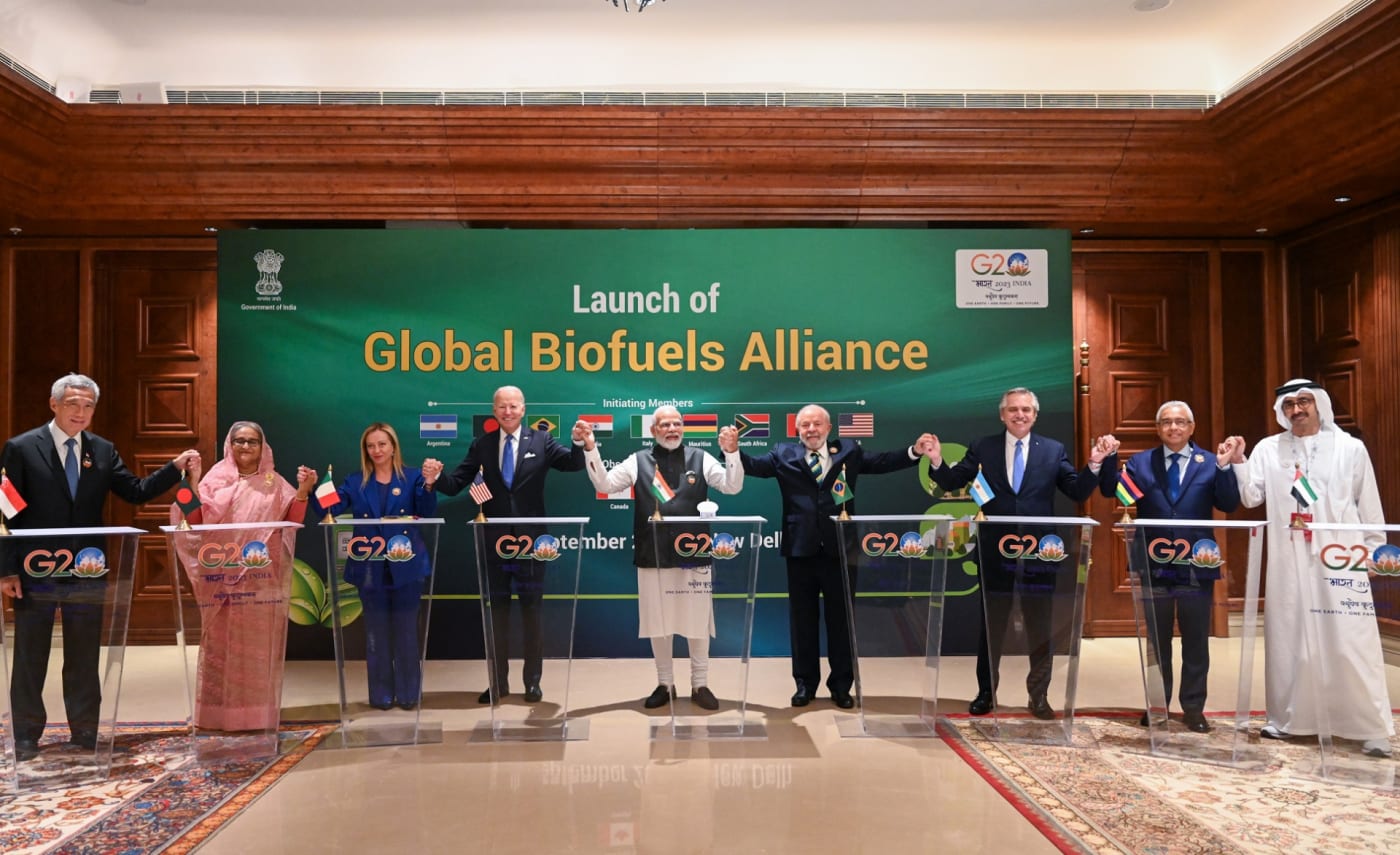
- Institutions: India founded the International Solar Alliance in 2015, now with more than 100 member countries and headquartered in Gurugram, and the Coalition for Disaster Resilient Infrastructure in 2019. The Global Biofuels Alliance, launched at the New Delhi G20, was built together with BRICS partner Brazil and the United States. See the India-led alliances →
- Digital public infrastructure: UPI handled more than 240 billion transactions in 2025-26 — a model of low-cost, open digital payments that countries across the Global South are studying closely. See the numbers →
The Business Forum also brought together the BRICS Women's Business Alliance, reflecting a priority India has pressed throughout its chairship: growth that is led by women, not merely extended to them.
When the guests go home
Summits are judged by their declarations, and this one will be too. But the impressions that last are often quieter: the warmth of a welcome, a meal remembered, a city seen for the first time.
Atithi Devo Bhava has always been about more than good manners. It is a way of saying that a guest's dignity matters as much as one's own. In a divided world, an expanded BRICS gathering in New Delhi under that idea is a message worth sending — and India is ready to send it.
Sources: BRICS India 2026 (official) · PIB: BRICS — Evolution, Cooperation and India's Leadership · PIB: Prime Minister's address at the BRICS Business Forum 2026 · Ministry of External Affairs: 18th BRICS Summit · G20 New Delhi Summit (official) · Deccan Herald: Konark wheel · All India Radio: Nataraja statue · The Tribune: Konark to Nalanda · Trade, exports, alliances and UPI figures: India Unfolding